
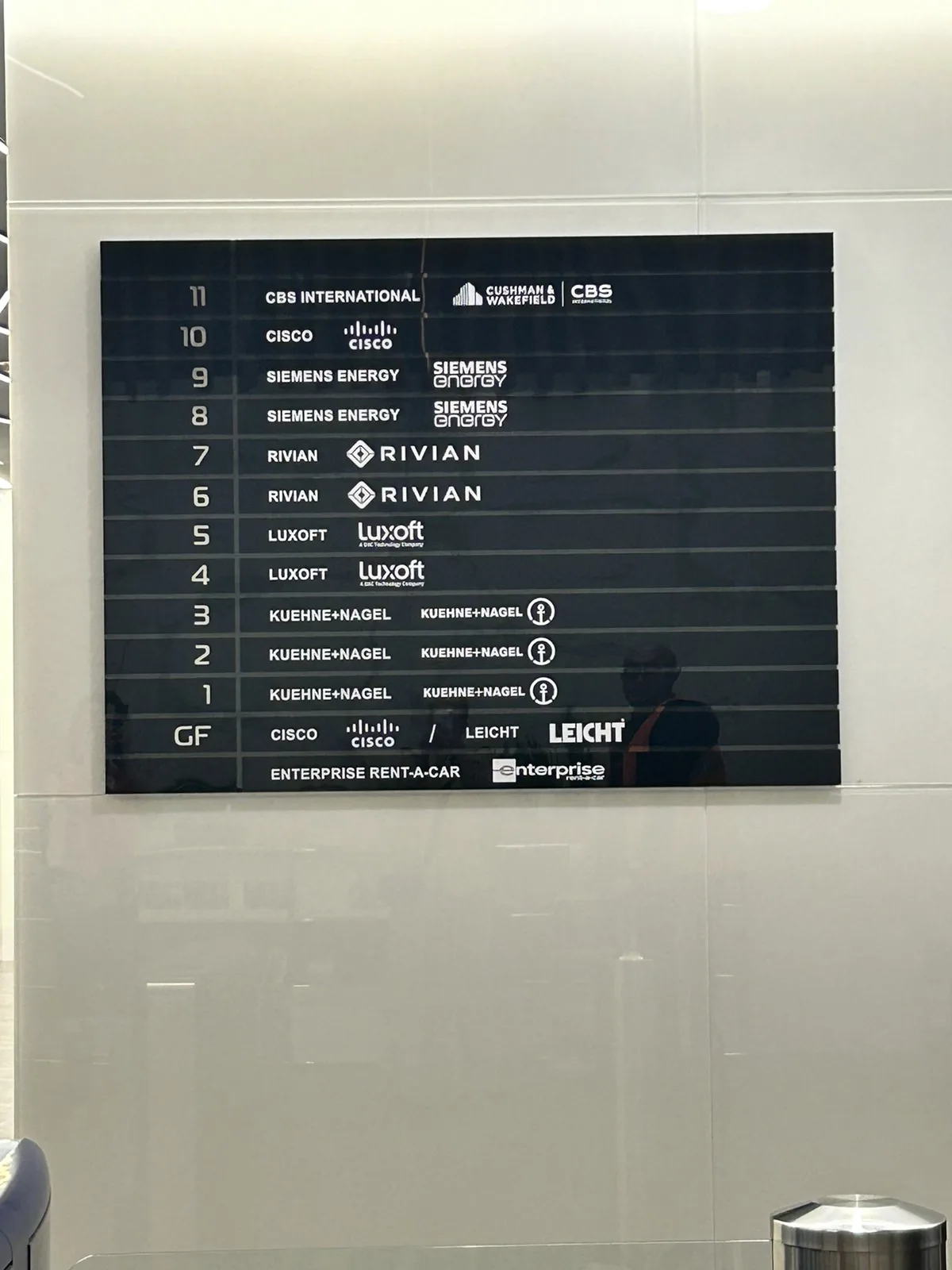
AFI City Zmaj
Office complex signage: the tenant directory in the entrance hall, floor signs at the lifts…
Products
The board in the lobby that answers one question: which floor is the thing I am looking for on. It changes more often than anything else in the building.
A directory is planned around change, not around the first fit-out. In an office building a tenth of the tenants change in the first year, and if every name is printed straight onto the panel, management pays for a new panel each time. So we build fields with inserts, on a grid that takes both long and short names without breaking.
Ordering is the other thing to settle up front: by floor or alphabetically. By floor works for a visitor who knows the company name and wants the lift; alphabetically works when there are many and the names are not memorable. Larger lobbies get both listings side by side, because that is what stops the question at reception.
The insert changes without tools and without taking the board off the wall.
Two ways of reading the same list, for the visitor who knows and the one who does not.
For buildings with several cores, where a list alone is not enough.
A smaller listing at the lift on each level, kept in step with the main directory.
A screen with a list edited from the management office, where changes are frequent.
Agreed insert changes when a tenant moves, without a new job every time.
Office complex signage: the tenant directory in the entrance hall, floor signs at the lifts…
Signage for a mixed-use development: office tower tenants, floor and lift signs, illuminated…
Office complex signage: external markings in front of the building, an illuminated directional…
It depends on the board height and the reading distance. We lay it out so the list can grow — spare fields are left, because empty fields are easier to fill than a board is to extend.
Digital makes sense when the list changes monthly or when the same board also carries notices. When it changes once a year, a printed insert is cheaper and does not depend on power.
Building staff can change inserts — that is why we build them that way. When management would rather not deal with it, changes go through an agreed maintenance arrangement.
Inside, a decision is made every few steps. We build a sign system that takes a visitor from…
Where content changes more often than boards can be replaced, the sign becomes a screen. We…
The document that protects the building's appearance after we leave. It prescribes how the…
Tell us the building type, its size and the stage it is at. These details help us prepare a more specific response.