
Graphic standards manual
The document that protects the building's appearance after we leave. It prescribes how the…
Guides
The document that stays with the building after we leave. It sets out how every future sign should look — so that in five years the fifth sign still matches the first.
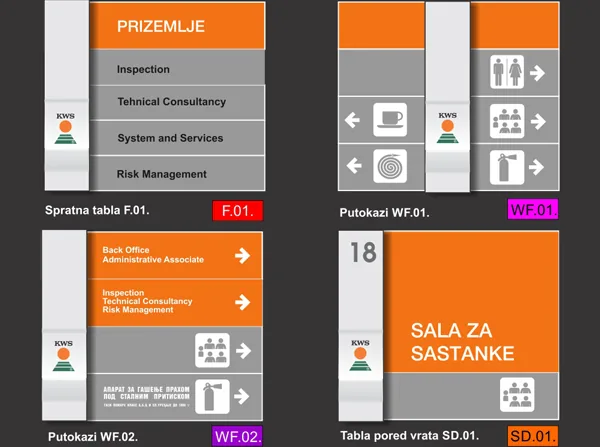
A standards manual is the signage rulebook for one building. It sets the typeface and sizes, the colours and their references, the margins on a panel, how bilingual text is set, which pictograms are used and at what height each type of sign hangs. Once written, anyone who works on the building afterwards has a single source instead of a free judgement call.
The reason it comes before the first sign is simple: a building is not signed once. After occupancy the additions start — a new tenant, a rearranged department, an extra door. Without rules, every addition is a fresh decision, and within a couple of years one floor shows three different systems. The manual does not prevent change; it stops change from breaking the whole.
For an investor it also has a plain financial side: additions are ordered against a specification, other contractors can execute them, and the design is not paid for again each time. That is why we put it first on buildings that will fill up in phases.
Typeface, weights, minimum cap heights and size against reading distance.
Colour references, permitted substrates and finishes, with examples of what is not used.
How content sits on a panel, so different formats read as one system.
A catalogue of types with dimensions, fixing method and mounting height.
The set in use, including mandatory safety pictograms to standard.
What may change, what may not, and who checks an addition.
No. A brand book governs a company's communication; a standards manual governs a building's signage. Where a brand book exists, the manual builds on it — taking the colours and typeface, and adding everything about panels, heights and materials.
It depends on the size of the building and the number of sign types. On a mid-sized building it runs in parallel with the signage design and is delivered with it.
They can, and that is the point. The specification is written to be ordered against, without redesign.
The document that protects the building's appearance after we leave. It prescribes how the…
Inside, a decision is made every few steps. We build a sign system that takes a visitor from…
The first sign a visitor sees is the one from the street. We design and deliver external…
Tell us the building type, its size and the stage it is at. These details help us prepare a more specific response.